Ceci est un event archivé de la Fête de la Culture 2026.
Images
Historic Building Tours
Visites et explorations
MuséeDate et heure
Fins de semaine, 10am–4pm
Lieu
Lincoln Museum & Cultural Centre
3800 Main Street, Jordan, L0R 1Y0
St. Catharines, ON
Accès
Gratuit.
Offert en Français.
Accessible en chaise roulante et a des toillettes neutres.
À propos
Our historic buildings are open for tours!
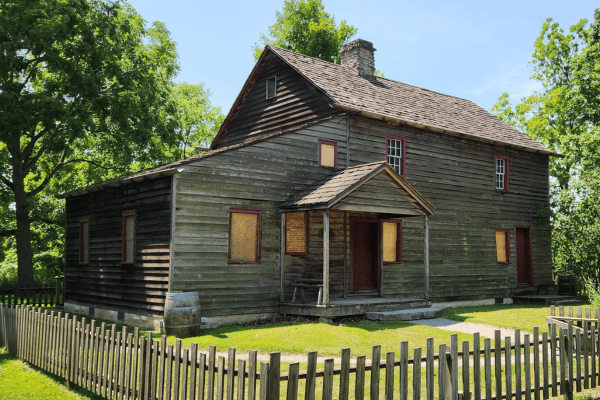
The Fry House is a two-story log dwelling built in c.1815 by Jacob Fry and Elizabeth Wismer, two of the early German-speaking Mennonite settlers from Bucks County, Pennsylvania. The house has been staged with period-relevant objects and functions as a living history site.
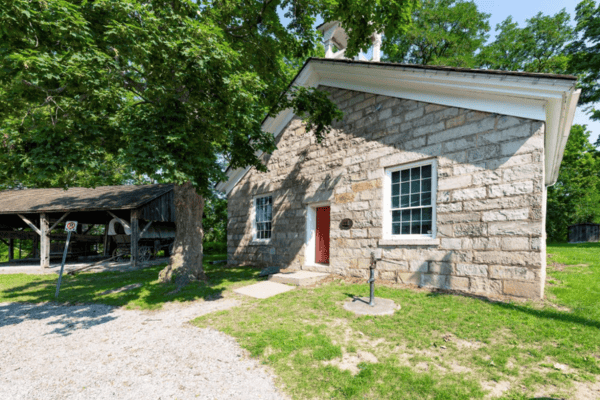
Built in 1859 to replace an earlier school that was destroyed by fire, S.S. #4 (School Section #4) was large and bright, with many windows and carefully chosen décor to encourage attention and obedience. This sturdy limestone structure hosted local children for 89 years until 1948. It was the centre of the community, used for the club meetings, adult language classes, and the much-anticipated annual Christmas pageant.
The schoolhouse has been authentically restored to show a typical rural classroom in 1908. During the summer, it is open for guided tours and throughout the year, students on field trips to experience a day-in-the-life of a turn-of-the century child.
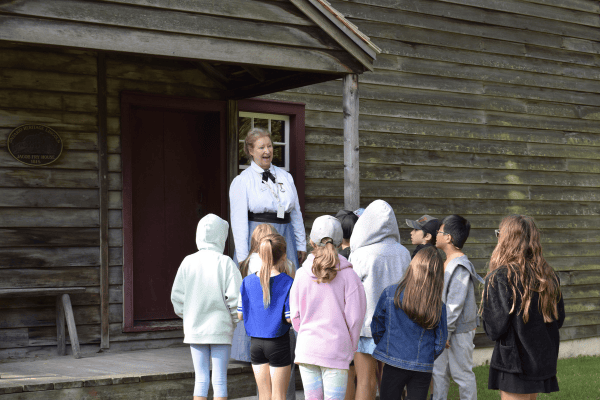
Explore the Fry House and schoolhouse with a costumed interpreter on Saturdays and Sundays in September and October from 10-4 p.m. .
Organisateur
Lincoln Museum & Cultural Centre
The Museum is located within the village of Jordan, Ontario. Our site encompasses 1.3 acres of land, bordered by the Niagara escarpment, and directly connects to the Twenty Valley Trail. Our site is also home to several historical buildings and commemorative sites, including the 1815 Fry House, the 1859 Schoolhouse, the Haines Cemetery, and a replica Conestoga wagon.
The Fry Family House is a two-story log dwelling built around 1815 by Jacob Fry and Elizabeth Wismer, two early German-speaking Mennonite settlers from Bucks County, Pennsylvania. Originally located near the intersection of Fly Road and Victoria Avenue in Vineland, the home is a rare surviving example of Pennsylvania German Traditional architecture in Canada. The house’s distinctly medieval form, with its steep roof, thick walls, and small, irregularly spaced windows, shows how European cultural traditions remained deeply rooted as they were passed down through generations.
Jacob and Elizabeth raised 12 children in the house, including their son Samuel Fry, a well-known local weaver. Jacob was a skilled cabinet maker and successful fruit grower. Multiple generations of the family lived in the home until 1892. In the following decades, the house was used as a playhouse and chicken coop. In 1959, to save the house from demolition, volunteers carefully transported it on a truck bed, floated it across the Twenty Mile Creek, and moved it down the Niagara Escarpment to its current site at the museum.
The Jordan Schoolhouse, also known as School Section #4 (S.S. #4), is a one-room school that served the children of Jordan for almost 90 years. Every element of the building was designed to foster attention and discipline, from its tall windows to its slanted floors and bright interior colours. The schoolhouse was also a social hub for the village, hosting society meetings, adult language classes, and the much-anticipated annual Christmas pageant.
Inside, students learned the three Rs (reading, ‘riting, and ‘rithmetic), moral instruction, and hands-on skills like carpentry and gardening for boys and domestic arts for girls. As many as 60 children aged 6-16 were taught by a single schoolmaster/mistress, who maintained a strict, military-style routine to keep order and efficiency.
The school closed in 1948. In 1953, Jordan Wines purchased the building and returned it to the community. Volunteers filled the space with agricultural tools and artifacts and opened it as Jordan’s first museum. The schoolhouse was later restored to reflect a typical 1908 classroom. School Board records and alumni memories guided the restoration efforts. Today, the schoolhouse has returned to its roots as a community hub with its immersive tours and school programs.