Entretien avec Michelle Bucholtz, ambassadrice de la Fête de la culture en C-B 2026
Thanh Lieu
14 août 2026
An Interview with Michelle Bucholtz, 2026 BC Culture Days Ambassador
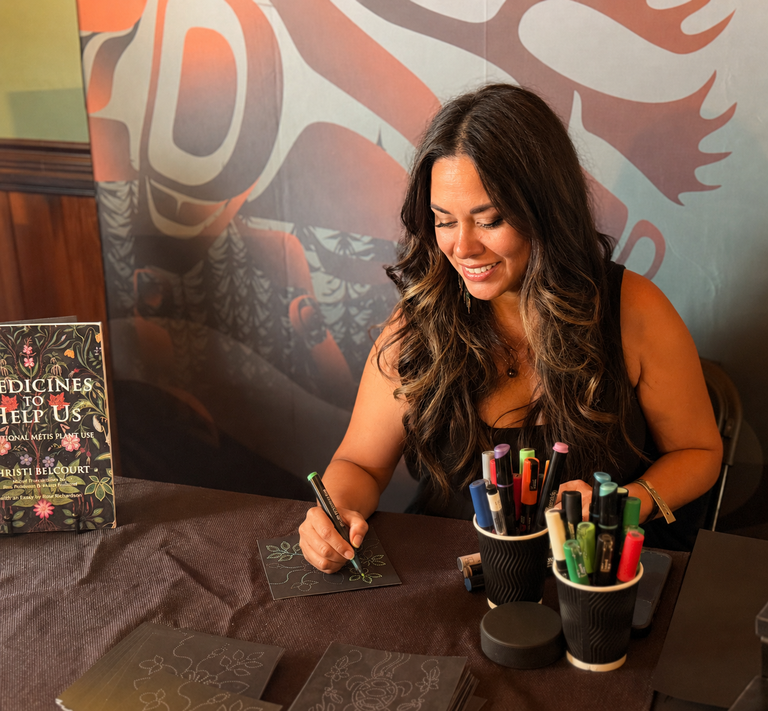
Michelle Bucholtz is a Métis artist, Registered Therapeutic Counsellor, and founder of Spirit Dot Designs based in Langley, British Columbia, who is also the 2026 BC Culture Days Ambassador.
BC Culture Days interviewed Michelle about her journey evolving within her craft, dot art, and her connection to BC Culture Days.
Thanh Lieu: How did you first learn about Culture Days, and why did you want to become an ambassador?
As an artist, I always look for opportunities to share my art designs because they all symbolize a personal struggle, revelation, or cultural teaching. Being part of Culture Days as an ambassador helps me to connect to people and share the work I do. And hopefully, my art speaks to them and helps them explore personal insights they haven’t had the opportunity to reflect on.. Art has helped me immensely. Creating is such a different language where we can express ourselves when we find it hard to put the language to it. It helps us slow down, and be present with ourselves and one another.
Every artist has their own definition of what art means to them. For you personally, how would you define art, heritage and culture?
Louis Riel once said “My people will sleep for 100 years. But when they wake, it will be the artists who give them their spirit back.” I can honour my Metis ancestors who had to hide their Indigenous identity - because at that time, they didn't have a choice - I feel privileged and grateful to have the choice to reclaim our culture because it’s a safer time to do so.
Additionally, as a transpersonal counsellor, I help people work on their struggles in relationship to themselves and others, and try to bring them back to their wholeness. For me, art is just another way of bringing you back to your authentic self.
However, I didn’t always have that relationship with art. I’m still learning what it means to be an artist.
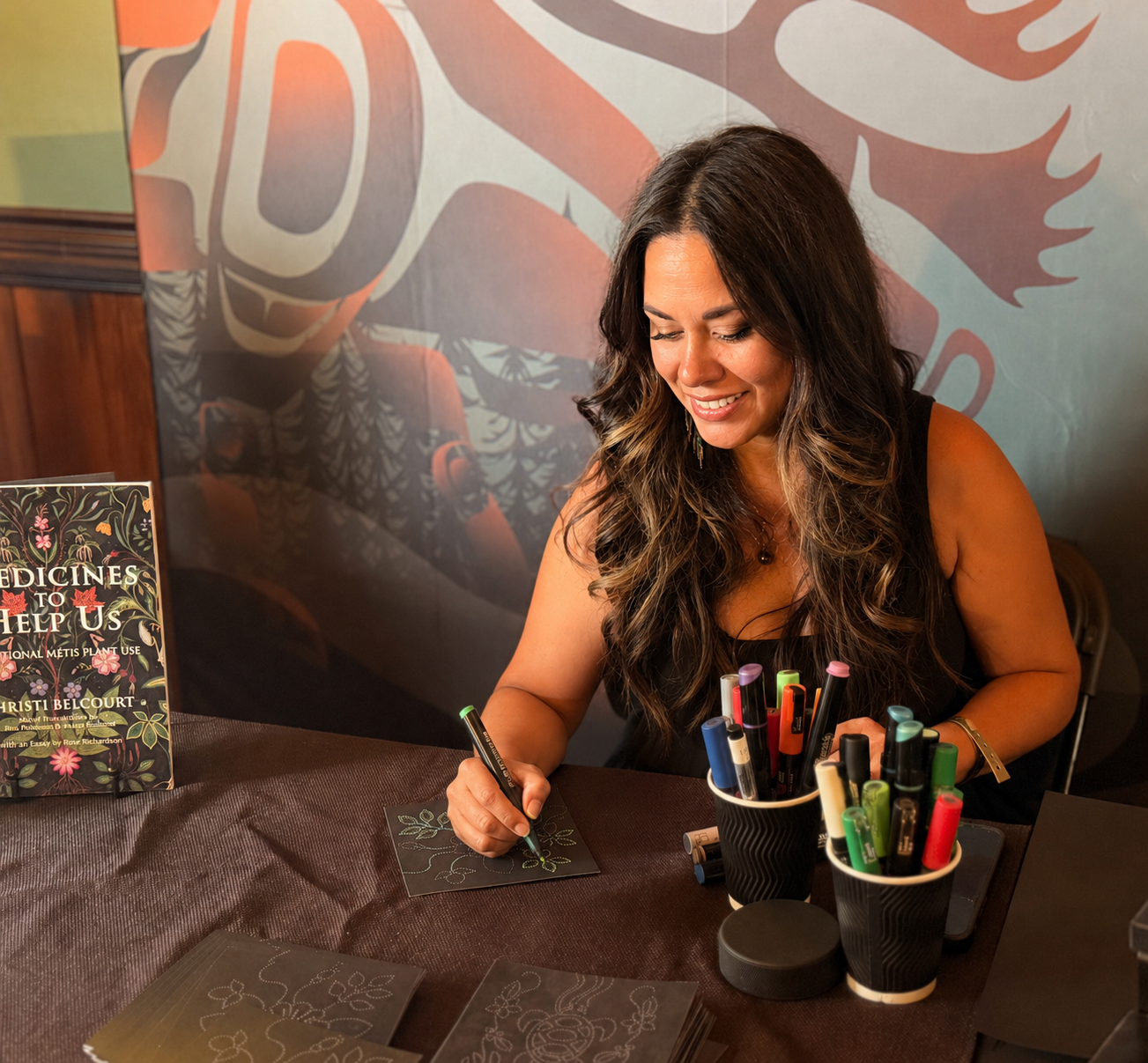
Currently, I’m in the creative Métis Creative Arts program at WHEAT Institute, where this has inspired me to become a Métis beadwork dot artist. Most of my designs are inspired by traditional teachings of the Métis beadwork. This form of art has shifted and transformed my relationship with art to be not performative or perfect, but to be authentically expressive.
I think we live in a world where productivity and certainty are valued, even in the arts. So, I’ve taken a moment to unlearn and rebuild my relationship with art that is all about being present with where I’m at, even if it feels unpleasant.
What has your journey been like working with dotted art and bringing this form of art to Culture Days?
Through BC Culture Days, I’ve had the opportunity to connect with a mentor. This time, I’m working with Leah Marie Dorion, a very well-known Métis artist, writer and educator.
Because I’m still early in my artistic journey, I know there’s so much for me to learn. But what has made dot art so meaningful for me is the teachings, the reconnection to culture, and the blood memory that it stirs up.
My first experience with dot painting was through knowledge keeper Kelly Poitras, who introduced it to me last year. When I first started dot painting on the rock, I thought to myself: “Oh my gosh, I used to do this when I was a kid!” I remembered sitting in class with those Costco napkins that had the embossed floral patterns on them, tracing and dotting over the designs. At the time, I was an undiagnosed neurodivergent child, and looking back, I realize that was how I regulated myself. It was grounding.
My mom still has all my old binders, and they’re covered in flowers I drew everywhere. I’m sure I even drew on my school desk and often got in trouble for it. [Laughs]
Dot art brought me back to that childhood memory: to who I was before I was conditioned to perform. As a competitive dancer for 25 years, I was trained to approach creativity through performance, compliance and precision. But dot art brought me back to a time when my creativity was innocent, and I’m able to reconnect with that younger version of myself.
There’s something beautiful about revisiting something from before you were conditioned to fit into the world. It was so pure and beautiful. That’s what this experience has been for me.
What have you learned about yourself throughout this process?
I’m exploring so many more facets of who I am. I think a part of me learned to stay small and shrink myself so that other people would feel comfortable. Art has become a way for me to take up space with integrity and not apologize for it. That’s also how I came up with the name of my art practice, Spirit Dot Designs, which was inspired by the spirit bead in Indigenous culture.
A spirit bead is an off-colour or off-set bead that is intentionally woven into beadwork or jewelry to represent imperfection and humility. As a recovering perfectionist, I often experience task paralysis and become overwhelmed during the creative process.
One Knowledge Keeper in my Métis Creative Arts program, Natalie Pepin, once told me, “Michelle, perfectionism is the enemy of done.” Both the spirit bead and Pepin’s words remind me that my process doesn’t have to be perfect. Intentionally placing a single imperfect dot within my designs reminds me that the process can be “flawsome” and beautiful precisely because of its imperfections. It also reminds me that I can strive for excellence while honouring my limitations. It’s a reminder to embrace flaws and meet my mistakes with grace,because like nature, it’s beautiful and it’s not perfect.
What’s a fun fact about you that most people don’t know?
Most people are surprised to learn that before becoming a counsellor and an artist, I spent 25 years as a Polynesian dancer. From a young age, I learned cultural dances from Hawaiʻi, Tahiti, and Aotearoa (New Zealand), along with the languages, chants, and traditions that accompany them. I was trained by a Kumu Hula (master hula teacher) in a traditional hālau (hula school) and had the opportunity to compete internationally.
Learning Polynesian cultural traditions, languages, stories, and teachings gave me a deep respect for Indigenous cultures. Reclaiming my Métis culture has taught me to both respect and live Indigenous culture.
Can you share a little bit more about your Culture Days event this year, Spirit Dots: A Métis Nature & Dot Art Experience?
The Turtle Water painting design we are painting at my BC Culture Days workshop is the design I made listening to Christie Belcourt teach in the Métis Arts and Activism Course in the Métis Creative Arts Program. Her activism, teachings and talks inspired this design that has a turtle, water and is surrounded by sacred plant medicines. These cultural themes will be explored during my event for BC Culture Days.